Dividend Portfolio Allocation by Age — 30s 40s 50s Income Strategy Guide
Most investors don’t fail because they choose the wrong ETF — they fail because they use the wrong allocation for their age.
A 30-year-old chasing income is wasting growth. A 50-year-old chasing growth is risking income collapse. The real problem isn’t what you invest in — it’s how you structure your portfolio over time.
This guide gives you a clear, actionable system to build the right dividend portfolio for your stage of life — so your income grows when it should, and stabilizes when it must.
👉 Decision Point: The wrong allocation today can cost you 10–20 years of income growth.
👉 And most investors don’t realize this until they’ve already lost years of growth.
30s → 80% Growth ETFs / 20% Bonds
40s → 60% Dividend ETFs / 40% Income Assets
50s → 40% Dividend ETFs / 60% Stable Income
👉 If you don’t know where to start, use this allocation now.
You are now at the final step of building your income system.
👉 Step 1: Choose your strategy (Income vs Growth)
👉 Step 2: Build your ETF mix
👉 Step 3: Accelerate income (Snowball)
👉 Step 4: Optimize by age (You are here)
👉 Explore Full Passive Income System
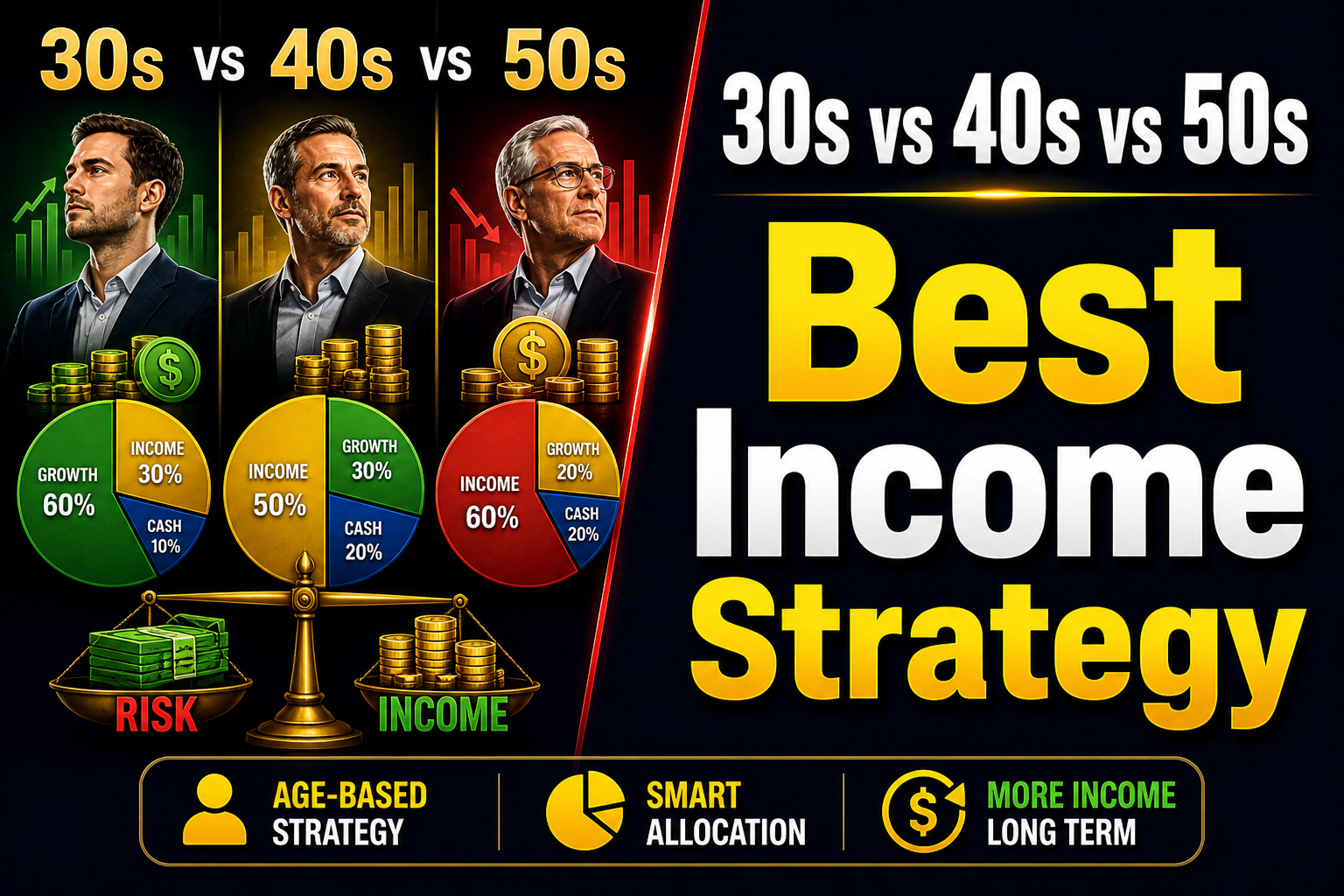
- 30s → Focus on growth and compounding
- 40s → Balance income and growth
- 50s → Prioritize stable income
- Allocation matters more than yield
The biggest mistake investors make is using the same strategy at every age.
👉 Allocation timing matters more than ETF selection.
- Dividend strategies shifting toward hybrid income models
- Bond yields competing with dividend income
- Allocation flexibility now critical for income investors
Table of Contents
- Allocation drives income, not just ETF choice
- Growth early → stability later is the winning formula
- Income without growth loses value over time
- A structured plan beats random investing
| Strategy | 30s Outcome | 50s Outcome |
|---|---|---|
| Income Focus Early | Slow growth | Low income |
| Growth First Strategy | Fast growth | High income |
And that decision quietly limits their future income.
👉 See which strategy actually builds more wealth →
1. 30s Strategy — Build Income Through Growth
In your 30s, your biggest advantage is time — not income. The goal is not to maximize dividends today, but to build a foundation for future income.
Example:
- Invest $500/month
- Annual return ~8%
- 20 years → portfolio grows to ~$300,000+
Trying to generate income too early slows this growth dramatically.
Decision: Focus on growth now to create much larger income later.
2. 40s Strategy — Balance Growth and Income
In your 40s, income starts to matter — but growth still plays a role. This is where most investors make mistakes by going too conservative too early.
Example:
- $300,000 portfolio
- Dividend income: ~$9,000/year
- Additional bond income: ~$6,000/year
Total income: $15,000/year
👉 Learn full allocation strategy:
Allocation Guide
Decision: Balance income with continued growth — don’t sacrifice future earnings.
3. 50s Strategy — Secure and Protect Income
In your 50s, the priority shifts completely — your portfolio now supports your lifestyle.
Example:
- $500,000 portfolio
- Dividend yield ~3.5% → $17,500/year
- Bond income → $10,000/year
Total income: ~$27,500/year
👉 Compare income stability:
Income Strategy Guide
And that’s why their income never scales.
👉 Learn how to accelerate your income →
Wrong allocation:
$300K → $12,000/year
Optimized allocation:
$300K → $20,000+/year
👉 The difference is not ETFs — it's allocation timing.
Decision: Stability first — growth becomes secondary.

4. Allocation Logic — Build the Right Structure
| Age | Goal | Allocation | Income Level |
|---|---|---|---|
| 30s | Growth | 80/20 | Low → High |
| 40s | Balance | 60/40 | Medium |
| 50s | Income | 40/60 | High Stable |
This structure ensures your portfolio evolves with your life stage.
Decision: Adapt allocation as your priorities change.
5. Income Strategy — Build Predictable Cash Flow
The goal is simple: consistent and growing income.
Example monthly income:
- Dividend ETFs: $1,200/month
- Bonds: $800/month
- Total: $2,000/month
👉 Build your system:
Monthly Income Strategy
Decision: Build multiple income streams, not just one.
- Using the same strategy at every age
- Chasing high yield too early
- Ignoring income stability later
Result: Lower lifetime income
Income Simulation — What This Actually Looks Like
- 30s → $500/month → 20 years → ~$300,000
- 40s → $1,000/month → 15 years → ~$350,000
- 50s → $500,000 → ~$25,000/year income
This is how structured allocation turns into real money.
Conclusion — What You Should Do Now
Most investors fail because they don’t change strategy as they age.
- 30s → maximize growth
- 40s → balance income
- 50s → protect income
Final Decision:
Choose the allocation that matches your life stage — not your emotions.
Your strategy is now clear.
Your portfolio is built.
Your income is growing.
Now, keep optimizing and scaling your system.
👉 Return to Full Strategy Hub
FAQ
Q. Should I use the same allocation at all ages?
No. Your strategy must evolve as your income needs change.
Q. When should I shift to income investing?
Typically in your 40s, when income becomes more important.
Q. Is growth still important in your 50s?
Yes, but stability becomes the priority.
Q. What happens if I stay too aggressive?
You risk income instability during market downturns.
Q. What is the safest income strategy?
A diversified mix of dividend ETFs and bonds.


